
Related Articles
Cinema advertising in India is seeing a rush of advertiser demand around one film, but it is still a small medium that works best when it is timed. The film Ramayana, released on November 5, 2026, created what UFO Cine Media Network's Sachiin Guptaa estimates is a Rs 80 to 100 crore cinema ad opportunity, Storyboard18 reported on November 16. By our calculation, that is roughly a tenth of a year's cinema ad spend, which the Pitch Madison Advertising Report put at Rs 877 crore in 2025. PVR INOX says its ad inventory for the season is sold out. Cinema was still only 0.8 percent of India's ad spend in 2025, so brands should buy it as a high-attention layer around the right films and plan reach elsewhere.
This guide covers the Ramayana ad rush, how big the market is, who is buying, whether regular weeks are worth buying and how to plan for the next big releases. It reflects reports published up to November 22, 2026.
Key Takeaways
- Ramayana set off a cinema ad rush. UFO's Sachiin Guptaa estimates a Rs 80 to 100 crore opportunity, and PVR INOX says its ad inventory for the season is sold out, according to Storyboard18.
- The medium is small. The Pitch Madison Advertising Report puts cinema at Rs 877 crore in 2025, 0.8 percent of ad spend. FICCI-EY puts it at about Rs 930 crore.
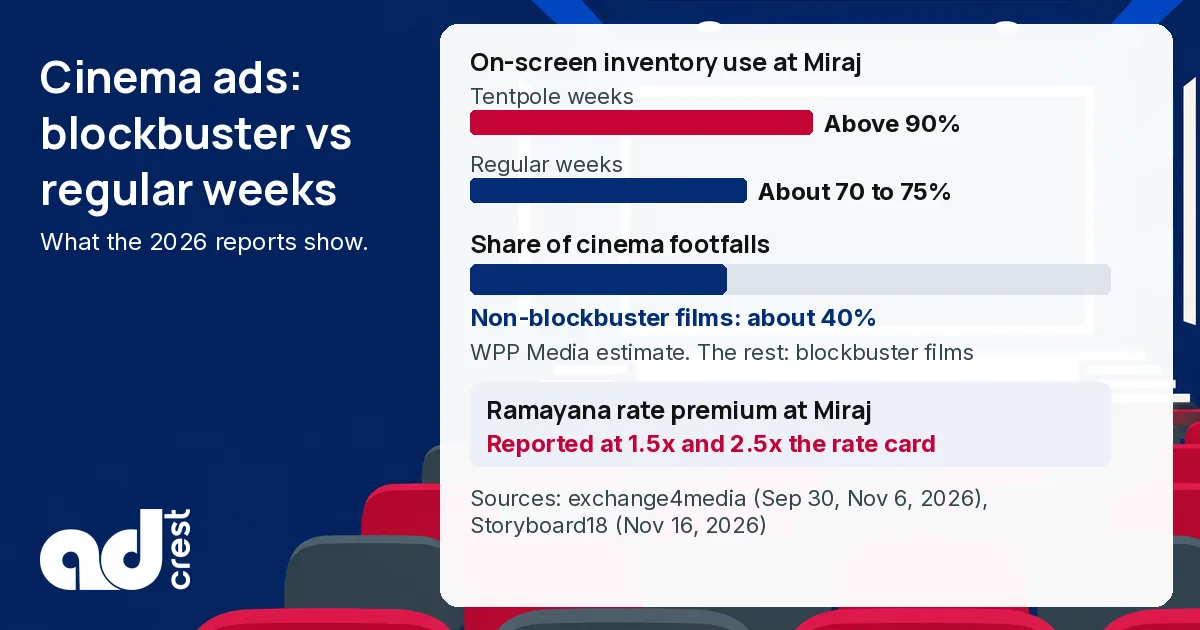
- Premiums are real but reported differently. Miraj's Ramayana rate premium is reported at about 1.5 times its rate card by Storyboard18 and about 2.5 times by exchange4media.
- Regular weeks still count. WPP Media India's Dhirender Suri says about 40 percent of cinema footfalls come during non-blockbuster films, when Miraj's inventory use is lower.
- Book early and ask for proof. Tentpole slots sold out early, and buyers now ask about actual footfalls, audience quality and cost per impact.
In This Article
- Why is cinema advertising suddenly in demand?
- How big is cinema advertising in India in 2026?
- What did the Ramayana ad rush look like inside cinemas?
- Which brands are buying cinema now, and why?
- Is cinema only worth buying in blockbuster weeks?
- What can brands buy beyond the 30-second spot?
- How should brands plan cinema advertising for the next big releases?
- The bottom line
- Frequently asked questions
Why Is Cinema Advertising Suddenly in Demand?
A blockbuster is the short answer. Ramayana Part 1 released on November 5, and Sacnilk figures that Hindustan Times reported on November 22 put its India net collection at Rs 942.75 crore by day 18. Box office trackers count differently and the numbers change daily, so treat that as one tracker's figure on one date. Moneycontrol reported on November 16, citing Ormax, that India's 2026 box office stood at Rs 12,534 crore as of November 15, up 13 percent from a year earlier.
Cinema is also part of other national campaigns this month. Google's Gemini ran a three-film campaign by Bare Bones Collective across digital, TV, cinema and social, according to ET BrandEquity on November 19 and exchange4media on November 21. Neither report gives a spend or results figure.
How Big Is Cinema Advertising in India in 2026?
The Pitch Madison Advertising Report (PMAR) puts cinema advertising at Rs 877 crore in 2025, up 3 percent from Rs 851 crore in 2024 and 0.8 percent of India's total ad spend, exchange4media reported on February 24, 2026. The medium is still below its 2019 peak.
| Year | Cinema ad spend (Rs crore) |
|---|---|
| 2019 (peak) | 1,045 |
| 2020 | 182 |
| 2021 | 136 |
| 2022 | 568 |
| 2023 | 776 |
| 2024 | 851 |
| 2025 | 877 |
| 2026 (forecast) | 921 |
PMAR calls 2025 a post-recovery plateau and describes cinema as an add-on impact layer. A second count, the FICCI-EY 2026 media and entertainment report, puts cinema advertising at INR 9.3 billion (about Rs 930 crore) in 2025, a marginal increase, and estimates INR 10 billion for 2026. Miraj Entertainment's Deepak Adwani put the market at about Rs 1,000 crore, exchange4media reported on November 6. We have not seen the full method behind each estimate, so read them as a range.
What Did the Ramayana Ad Rush Look Like Inside Cinemas?
Image: Storyboard18. Click to read the full report.
PVR INOX's Gautam Dutta, CEO of Revenue and Operations, told Storyboard18 that all ad inventory for the season was sold out. He said "The response from advertisers has been extremely encouraging." PVR INOX gave no revenue figure, only that Ramayana ad revenue should be at par with or above other major blockbusters.
Miraj Entertainment gave more detail. Adwani said the film opened on 225 Miraj screens with about 960 to 1,000 shows a day, and that almost all opening-week on-screen inventory had already been sold, according to both exchange4media (November 6) and Storyboard18. Storyboard18 adds that occupancy at Miraj has stayed above 90 percent since release, against about 60 to 65 percent for a regular release. The report does not define the term, though elsewhere it refers to inventory occupancy. It also says about a third of the brands on the film are new advertisers, and that ad spends with Miraj are 35 to 40 percent higher than for a regular big release.
The reports differ on the price premium. exchange4media quoted about 2.5 times Miraj's regular rate card. Storyboard18 quoted about 1.5 times, with ad revenue two to two and a half times that of a regular blockbuster. We cannot tell which is right, so read the premium as a range of about 1.5 to 2.5 times.
exchange4media also counted about 13 minutes of ads before the first trailer at one Ramayana screening. That is one show, so it says little about the market average.
Which Brands Are Buying Cinema Now, and Why?
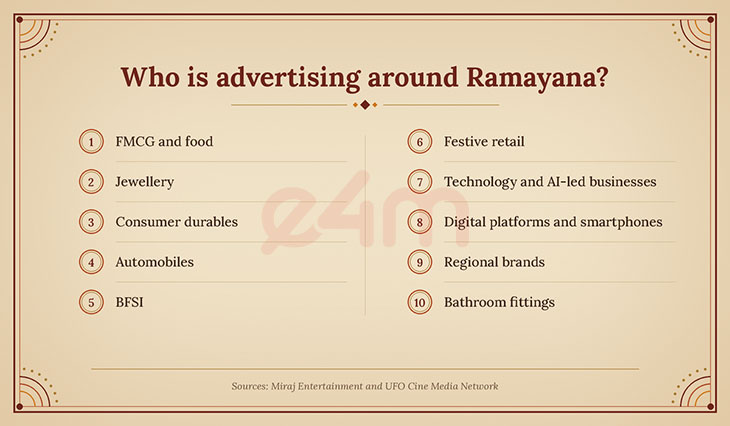
Image: exchange4media. Click to read the full report.
Both reports list FMCG and food, jewelry, consumer durables, BFSI, automobiles and festive retail, and Storyboard18 adds e-commerce and fintech. UFO also pointed to tech and AI-led businesses, digital platforms and smartphones. Storyboard18 also reports regional advertisers coming in, particularly in tier-2 and tier-3 markets. UFO's view is that there are two kinds of buyers: brands that build the film into their communication and brands that use it to amplify a campaign already running.
At the screening exchange4media attended, the pre-film reel included SBI Mutual Fund, Nippon India Mutual Fund, Birla Opus, Colgate, Thums Up, Audi, L'Oreal Paris and Sensodyne, and the interval carried Havells, Fevicol, Oppo, Ray-Ban Meta and Joyalukkas. That is one screening, and the report does not say these brands bought Ramayana-specific packages. An industry source named Joyalukkas, Pepsi, UltraTech and Hero among the highest-paying advertisers.
Is Cinema Only Worth Buying in Blockbuster Weeks?

Image: BestMediaInfo. Click to read the full report.
Regular weeks matter too, though the economics change. exchange4media's September 30 report quoted Miraj saying its on-screen inventory use is above 90 percent in tentpole weeks and about 70 to 75 percent in regular weeks. Storyboard18's occupancy figure above gives a lower regular-release level of 60 to 65 percent, and it is not clear whether the two measure the same thing. WPP Media India's Dhirender Suri said about 40 percent of cinema footfalls come during non-blockbuster films. Amol Mohandas of Weave Through said "Cinema's strongest proposition is attention, not incremental reach."
Exhibitor results also move from quarter to quarter. UFO Moviez reported in-cinema ad revenue of Rs 33.4 crore for July to September, up 3 percent, after about 34 percent growth in April to June, according to BestMediaInfo on November 4. PVR INOX reported 46.3 million footfalls and 30.4 percent occupancy for the quarter, Moneycontrol reported on October 28. A GuruFocus summary of its earnings call says ad revenue stayed subdued in the first half of FY27 for lack of tentpoles, and that management expected Ramayana, King, Avengers and Love and War to lift it in the second half.
What Can Brands Buy Beyond the 30-Second Spot?
The core product is the on-screen spot of 10, 20 or 30 seconds. The Ramayana coverage lists more formats around it:
- In-venue branding. Lobby branding, standees, digital screens and entrance branding.
- Tie-ups. Food and beverage and ticketing partnerships and branded combos.
- Activations. Sampling, installations and experiential activations.
- Custom packages. Premium placements and integrated packages that combine on-screen ads with lobby branding, ticket and food and beverage co-branding, festive activations and sampling.
Suri said cinema has more than 32 touchpoints, with on-screen the most effective and the lobby next. Miraj said its average deal sizes rose 10 to 12 percent as brands bought bundles. Lobby screens work like DOOH, which we cover in our post on DOOH advertising in India. Pitch reports a pre-show window of 15 to 20 minutes.
Network reach differs. UFO held ad rights on 3,946 screens, 1,340 of them single screens, across 1,330 cities and towns as of September 30, 2026, according to BestMediaInfo. PVR INOX has 1,797 screens in 114 cities in India and Sri Lanka, and the GuruFocus summary says it is building a digital pay-per-eyeball ad platform that is about 8 to 10 months away.
How Should Brands Plan Cinema Advertising for the Next Big Releases?
Use these checks before you book cinema ads or compare cinema advertising cost quotes. Each one draws on the reports above:
- Choose films by audience, language and region. Mohandas describes a dependency between the content and the context, and Pitch reports that cinema campaigns are film and region specific.
- Book tentpoles early. Miraj had sold almost all opening-week Ramayana inventory by the day after release, and PVR INOX says its season is sold out.
- Budget for a premium. Miraj's Ramayana premium was reported at about 1.5 to 2.5 times its rate card, and producer Girish Johar told Pitch that prices rise at least 20 percent in high-demand periods.
- Look at regular weeks too. About 40 percent of footfalls come from non-blockbuster films, when inventory use is lower.
- Ask for proof. Advertisers now ask about actual footfalls, audience quality and cost per impact, Mohandas said, and Suri says pay-per-contact and pay-per-ticket-sold models are emerging.
- Mix networks. Combine multiplex chains with a network that reaches single screens, such as UFO's 1,340 single screens.
- Treat cinema as a layer. Pair it with TV, outdoor and digital video for reach.
The next windows are Avengers: Doomsday and King in December, according to Moneycontrol. Ramayana Part 2 is now expected around Diwali 2028, Hindustan Times and exchange4media reported. For the wider ATL mix, read our posts on why ATL advertising still builds the strongest brands, why integrated campaigns outperform single-channel ads and TV advertising without BARC ratings.
AdCrest's capabilities page lists Cinema Advertising among its ATL media services, covering on-screen and in-premise advertising, city and nationwide cinema networks, and language and demographic-aligned planning. If you are shortlisting a cinema advertising agency, read how to choose the best advertising agency for your business.
The Bottom Line
Ramayana showed that cinema advertising in India can sell out when a film draws a crowd, and that exhibitors will charge a premium for it. It also showed how small and timed the medium is: Rs 877 crore in 2025, with the Ramayana opportunity estimated at Rs 80 to 100 crore. A brand that picks films by audience, books tentpoles early, looks at regular weeks, when inventory use is lower, and asks for proof of footfalls can use cinema well.
Planning cinema or ATL media for your next campaign?
Share your brief, city list and target languages with AdCrest and talk through how cinema, outdoor, DOOH and other ATL media can work together in one plan.
Book a Call with AdCrestLast updated: November 23, 2026
Frequently Asked Questions
What is cinema advertising?
Cinema advertising, also called theatre advertising, is paid advertising shown in cinemas. The core format is an on-screen spot of 10, 20 or 30 seconds before the film and at the interval. Networks also sell premium placements, lobby branding, standees, digital screens, food and beverage and ticketing tie-ups, branded combos, sampling and experiential activations.
How big is cinema advertising in India?
The Pitch Madison Advertising Report puts it at Rs 877 crore in 2025, or 0.8 percent of India's ad spend, with a forecast of Rs 921 crore for 2026. FICCI-EY puts 2025 at about Rs 930 crore (INR 9.3 billion). The two counts differ, so treat them as a range, not one exact size.
How much ad money did Ramayana bring to cinemas?
UFO Cine Media Network's Sachiin Guptaa estimates a Rs 80 to 100 crore cinema ad opportunity around the film, according to Storyboard18. That is an estimate, not reported revenue. PVR INOX says its ad inventory for the season is sold out and gave no figure, and Miraj reports premium rates and about a third new advertisers.
Is cinema advertising only worth it during blockbusters?
Not only. Tentpole weeks sell out at premiums, but WPP Media India's Dhirender Suri says about 40 percent of cinema footfalls come during non-blockbuster films. Miraj reported on-screen inventory use of about 70 to 75 percent in regular weeks against above 90 percent in tentpole weeks.
How early should brands book cinema ads for a big release?
Early. Miraj had sold almost all opening-week on-screen inventory for Ramayana by the day after release, and PVR INOX says its ad inventory for the season is sold out, according to exchange4media and Storyboard18. The reports give no standard lead time, so ask each network for its booking deadline for the film you want.
Share
Trending Topics
-
 November 23, 2026
Cinema Advertising in India: What the Ramayana Ad Rush Means for Brands
-
 November 20, 2026
DOOH Advertising in India: How Much of It Is Really Programmatic?
-
 November 16, 2026
TV Advertising in India Without TRP Ratings: How to Plan in 2026
-
 November 15, 2026
Newspaper Advertising in India 2026: What the Latest ABC Data Says
-

-
-
 March 09, 2026
-

-
 Feb 23, 2026
-

-
 Feb 09, 2026
-

-
 November 19, 2025
How Are Modern Advertising Agencies Using AI to Boost Campaigns
-
 November 17, 2025
How the Best Outdoor Advertising Agencies in India Stand Out
-
 November 12, 2025
-
 November 10, 2025
How Do You Choose the Best Advertising Agency for Your Business
-
 November 07, 2025
-
 November 01, 2025
Abhishek Gupta
A strategy-led growth architect blending business insight, brand thinking, and execution rigor to build scalable, market-relevant brands.