
Related Articles
For years, marketing conversations have been framed as a binary choice. Offline or online. Traditional or modern. Billboards or Digital Ads.
This framing is not just incorrect. It is actively harmful for brands that want to scale sustainably.
The reality is simple. Smart brands do not choose between Billboards and Digital Ads. They design marketing systems where both work together. Each channel plays a different role in the customer journey, influences different psychological triggers, and solves different business problems.
This blog breaks down why ATL and Digital are not competing channels, what Billboard advertising still does better than any other medium, where Digital Ads perform best, and how brands that combine both unlock scale that neither channel can deliver on its own.
ATL vs Digital: A False Comparison
The comparison between ATL and Digital usually starts with budget discussions and ends with opinions. That is the wrong way to approach the problem.
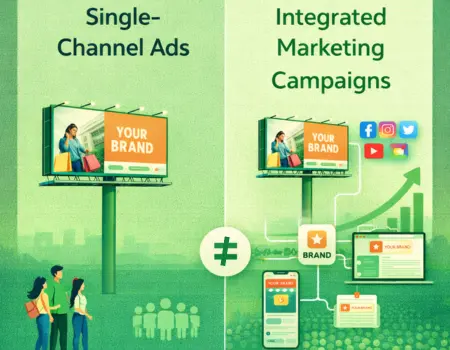
ATL and Digital are not substitutes. They are complementary layers within the same demand generation system.
ATL focuses on building brand presence at scale. Digital focuses on capturing and converting demand. When brands treat them as rivals, they weaken both.
The real question is not whether ATL is better than Digital or vice versa. The real question is where each fits in the decision making process of the consumer.
Different Roles in the Funnel
Modern funnels are not linear, but human psychology still follows patterns.
Billboards and ATL campaigns influence people before they are actively looking to buy. They work in the background. They create familiarity, legitimacy, and memory.
Digital Ads operate closer to action. They intercept users when intent already exists or when curiosity has been triggered. They push people toward clicking, inquiring, installing, or purchasing.
Billboards rarely drive instant conversions. Digital Ads rarely build deep trust on their own.
Smart brands design funnels where ATL warms the audience and Digital converts them.
Strengths of Billboard Advertising

Despite the dominance of screens and feeds, Billboards remain one of the most powerful branding tools available.
This is not nostalgia. This is behavioral science.
Visibility That Cannot Be Ignored
Unlike Digital Ads, Billboards cannot be skipped, blocked, muted, or scrolled past. They exist in the physical world and occupy unavoidable attention.
A commuter passing the same hoarding every day may not consciously read it, but their brain registers it repeatedly. This repetition builds familiarity. Familiarity reduces resistance. Reduced resistance increases brand preference.
This is why Billboard advertising excels at creating mental availability. When a consumer later encounters the brand online, it already feels known.
Billboards Signal Scale and Credibility
There is an unspoken assumption most people make when they see a brand on a large Billboard. That brand must be serious. It must be established. It must be trusted by others.
This signal is especially important for high consideration categories such as real estate, financial services, education, healthcare, automobiles, and premium retail.
A Digital Ad alone does not create this perception. A Billboard does it instantly.
ATL advertising tells the market that the brand is not hiding behind algorithms. It is confident enough to exist in the real world.
Billboard Advertising Builds Trust Before the Click
One of the most underestimated benefits of Billboards is pre conditioning.
When users have already seen a brand offline, they behave differently online. They click Digital Ads more readily. They spend more time on landing pages. They convert with fewer touchpoints.
Brands running consistent ATL often see higher click through rates, better conversion rates, and lower blended acquisition costs across their Digital Ads.
The Billboard does not generate the conversion directly. It makes conversion easier later.
Limitations of Billboards and ATL
Billboards are powerful, but they are not all-purpose tools. Using them effectively requires understanding what they cannot do.
Limited Direct Attribution
Billboard advertising does not offer click tracking, pixel based attribution, or real time optimization. Measuring its impact requires indirect indicators such as brand search growth, direct traffic lift, geographic performance, and conversion efficiency over time.
This does not make Billboards unmeasurable. It means they must be measured differently.
Expecting ATL to behave like Digital Ads is a category error.
Message Simplicity Is Mandatory
Billboards force discipline. They demand one idea, one emotion, and one memory hook.
They are not suitable for long explanations, feature lists, or complex offers. This limitation is also their strength. It forces brands to clarify what they stand for.
When used correctly, a simple Billboard message becomes a powerful anchor in the consumer’s mind.
Where Digital Ads Fit Best
If Billboards create gravity, Digital Ads create movement.
They turn awareness into action.
Capture and Conversion
Digital Ads perform best when intent exists or can be triggered quickly.
Search Ads capture users actively looking for solutions. Social Ads interrupt with relevance and curiosity. Retargeting reminds users who are already engaged. Performance creatives test messaging, offers, and formats at scale.
Digital Ads thrive on immediacy and precision. They are essential for lead generation, ecommerce sales, app installs, event registrations, and direct response campaigns.
Measurability and Optimization
One of the biggest strengths of Digital Ads is feedback. Every impression, click, and conversion creates data. This allows marketers to test, learn, and optimize continuously.
Budgets can be shifted in real time. Creatives can be refreshed weekly. Audiences can be refined based on performance.
This flexibility makes Digital Ads indispensable for growth focused brands.
Digital Ads Without Brand Trust Are Expensive
However, Digital Ads struggle when brand familiarity is low.
When users do not recognize a brand, they hesitate. They scroll past. They abandon forms. They bounce from landing pages.
This drives up CPMs, lowers CTRs, and increases cost per acquisition.
This is the invisible cost of relying only on Digital Ads. Without ATL support, performance marketing becomes a race to the bottom.
Billboards vs Digital Ads: The Real Difference
The difference between Billboards and Digital Ads is not about which is superior. It is about what each controls.
Billboards control attention, perception, and memory.
ATL controls legitimacy and scale.
Digital Ads control precision, intent, and conversion.
When brands try to force one channel to do the job of the other, performance suffers.
How to Combine Both for Scale
Step One: Use Billboards to Build Familiarity
Billboards should focus on brand presence and category association. The message must be bold, clear, and consistent across locations.
The objective is not education. The objective is recall.
When someone sees your brand name later on their phone, it should feel familiar.
Step Two: Align Digital Ads With ATL Presence
Once Billboards are live, Digital Ads should be synchronized.
Brand search campaigns should be strengthened. Geo targeted ads should be activated around Billboard locations. Visual elements from ATL should be echoed in digital creatives.
This overlap creates recognition. Recognition drives response.
Users who saw the Billboard yesterday are more likely to click the Digital Ad today.
Step Three: Let Digital Do the Heavy Lifting
Once attention exists, Digital Ads take over.
They explain the offer. They provide proof. They retarget interested users. They push conversions and follow ups through CRM and automation.
ATL opens the door. Digital walks the customer through it.
Real World Use Cases
High Consideration Services
Industries like real estate, finance, healthcare, and education benefit massively from combining ATL and Digital.
Billboards establish trust quickly. Digital Ads capture inquiries efficiently. Together, they shorten decision cycles and improve lead quality.
Retail and D2C Brands
Retail brands using Billboards often see higher footfall, better store recall, and stronger local dominance.
When paired with local search ads, store locator campaigns, and hyperlocal retargeting, Billboard advertising becomes a powerful revenue driver.
New Market Entry
When brands enter new cities, ATL creates instant presence. Digital Ads capture curiosity and demand.
The brand feels established faster. Adoption accelerates. Competitors struggle to match perceived scale.
Measuring Success the Right Way
Measuring ATL with digital metrics is a mistake.
Instead, brands should track brand search growth, direct traffic lift, improved conversion rates, reduced acquisition costs, and geographic performance shifts.
When these indicators improve after launching Billboards, the strategy is working.
The Future Is Integrated, Not Channel Led
Consumers do not think in terms of channels. They experience brands as a continuous presence across roads, screens, feeds, stores, and searches.
The brands that win are the ones that show up consistently across both physical and digital environments.
Final Thoughts
The debate between Billboards vs Digital Ads is outdated.
ATL is not dead. Digital is not enough on its own. Billboard advertising is not inefficient. Digital Ads are not automatically trustworthy.
Smart brands use Billboards to build belief and Digital Ads to harvest intent.
When combined strategically, the result is not just better marketing. It is lower costs, faster scale, and stronger brands.
If growth is the goal, stop choosing sides. Start designing systems.
Share
Trending Topics
-

-
-
 March 09, 2026
 -
-
 Feb 23, 2026
 -
-
 Feb 09, 2026
 -
-
 November 19, 2025
How Are Modern Advertising Agencies Using AI to Boost Campaigns
-
 November 17, 2025
How the Best Outdoor Advertising Agencies in India Stand Out
-
 November 12, 2025
 -
 November 10, 2025
How Do You Choose the Best Advertising Agency for Your Business
-
 November 07, 2025
 -
 November 01, 2025
Abhishek Gupta
A strategy-led growth architect blending business insight, brand thinking, and execution rigor to build scalable, market-relevant brands.