Related Articles

In a world dominated by screens, feeds, and endless scrolling, brands are fighting harder than ever for attention. Digital advertising has made reach accessible, targeting precise, and tracking measurable. Yet one fundamental marketing objective still challenges online channels: lasting memory.
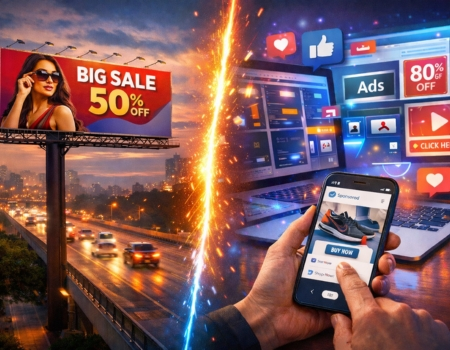
Brand recall is not built through clicks alone. It is built through presence, repetition, and emotional imprint. This is where OOH Advertising continues to outperform online ads.
From billboards on highways to transit shelters, metro wraps, and urban displays, OOH Advertising creates physical brand experiences that stay in memory longer. While digital campaigns drive immediate responses, OOH Advertising strengthens Brand Recall in ways that online formats struggle to replicate.
Understanding why requires a closer look at how memory actually works.
Understanding Brand Recall
Brand Recall is the ability of consumers to remember a brand when prompted by a category or need. It is not just recognition. It is spontaneous memory retrieval.
When someone thinks about buying a home, booking a doctor, or choosing a financial service, the brands that surface first in their mind are the ones with strong Brand Recall.
This mental availability directly influences purchase decisions.
How Memory Is Formed
Human memory is built through repeated exposure and emotional association.
Psychologists explain that memory strengthens when three factors are present:
- Repetition over time
- Contextual consistency
- Emotional relevance
OOH Advertising supports all three.
Repeated exposure to a physical display on a daily commute creates familiarity. Familiarity reduces cognitive effort. Reduced effort increases preference.
Unlike digital impressions that appear briefly and disappear, OOH Advertising exists continuously in real world environments. It becomes part of a consumer’s daily visual landscape. This persistence helps convert exposure into Brand Recall.
The Difference Between Recognition and Recall
Recognition occurs when a consumer sees a brand and identifies it. Recall occurs when the brand comes to mind without visual prompting.
Digital ads often create recognition. OOH Advertising strengthens recall.
When a brand is visible in high traffic locations consistently, the brain encodes it as established and reliable. That encoding increases Brand Recall during decision making moments.
Why Physical Visibility Matters
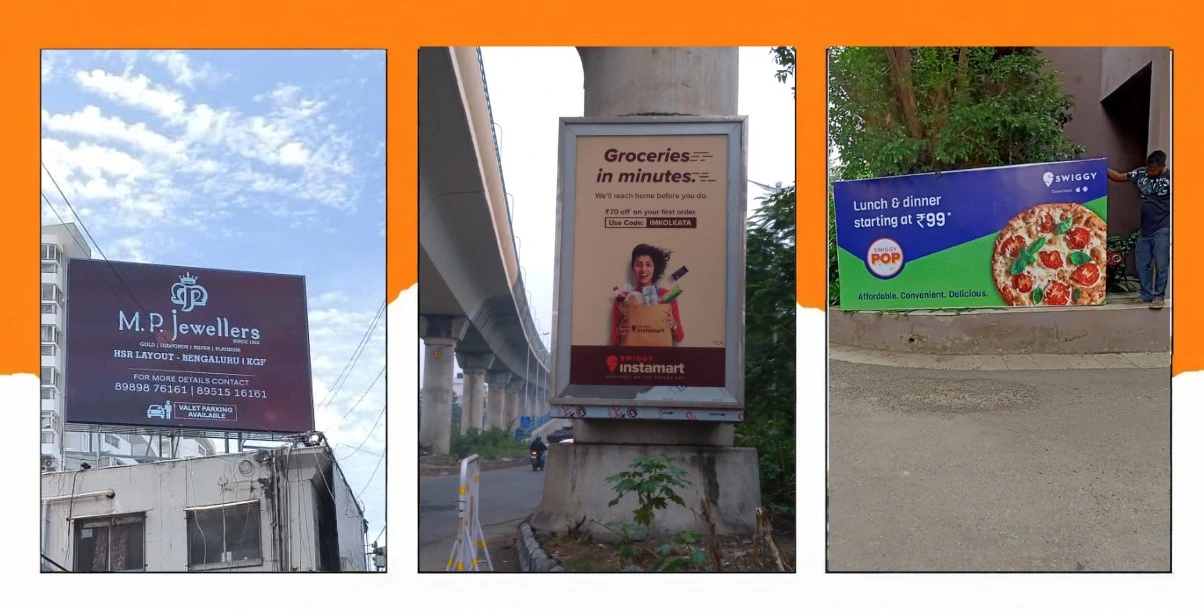
Physical presence has psychological weight. When a brand occupies space in the real world, it signals stability and scale.
OOH Advertising leverages this physical authority to build credibility.
Repetition and Presence
Repetition is one of the strongest drivers of Brand Recall. Seeing the same creative multiple times during a commute reinforces memory traces.
OOH Advertising excels at sustained repetition. A billboard is visible 24 hours a day. It does not rely on algorithmic delivery. It does not compete with dozens of other distractions on a single screen.
This uninterrupted visibility creates cognitive imprint.
Online ads, by contrast, appear briefly. They compete with notifications, messages, videos, and endless content. Even if they generate impressions, they rarely secure focused attention.
Physical repetition creates deeper encoding than fragmented digital exposure.
Context Strengthens Memory
Memory is influenced by environment.
When a brand message appears consistently in a physical setting such as highways, business districts, or transit stations, the brain associates it with that location.
Later, when a related need arises in a similar context, Brand Recall improves.
For example, financial services promoted through OOH Advertising near corporate hubs may experience stronger Brand Recall among working professionals. Real estate brands visible near residential areas reinforce category association.
Digital advertising lacks this environmental anchoring. Ads appear in constantly shifting contexts with limited physical relevance.
Trust and Perceived Legitimacy
Physical visibility communicates seriousness.
Consumers often interpret OOH Advertising as a sign of investment and commitment. A brand that appears on a major highway or prime urban location is perceived as established.
This perception supports Brand Recall because trust enhances memory retention. People remember brands they consider credible.
Online ads alone may not generate the same authority signal. They are accessible to all businesses, including small and unknown players. Without offline presence, digital exposure may not convert into long term Brand Recall.
Digital Limitations in Brand Recall
Digital advertising is powerful for targeting and conversion. However, it faces structural limitations when it comes to strengthening Brand Recall.
Fragmented Attention
Online platforms are designed for speed and constant content consumption. Users scroll rapidly. Ads are often viewed for seconds or less.
This fragmented attention weakens memory encoding.
Even when digital campaigns achieve high impressions, those impressions may not translate into strong Brand Recall.
Ad Fatigue and Banner Blindness
Users are exposed to thousands of online ads daily. Over time, they develop banner blindness. They subconsciously ignore advertising placements.
This reduces the effectiveness of digital campaigns in building lasting memory.
OOH Advertising does not face the same level of clutter. While cities are competitive spaces, the scale and format of OOH placements command attention differently than small digital banners.
Skippable and Blockable Formats
Many online ads can be skipped, muted, or blocked entirely. Consumers exercise control over digital environments.
OOH Advertising cannot be skipped. It occupies unavoidable space in physical environments.
This forced visibility enhances Brand Recall because exposure is consistent and reliable.
Short Campaign Cycles
Digital campaigns are often optimized rapidly. Creatives change frequently. Messaging rotates based on performance metrics.
While this flexibility improves conversion, it can dilute long term Brand Recall if brand consistency is not maintained.
OOH Advertising typically runs for longer durations in fixed locations. This stability reinforces brand identity and memory retention.
Using OOH to Anchor Brand Identity
OOH Advertising does more than create awareness. It anchors brand identity in public space.
Creating Visual Memory Cues
Large format displays allow brands to use bold colors, strong typography, and simplified messaging. These elements create strong visual memory cues.
When repeated across locations, these cues become symbolic of the brand.
Brand Recall strengthens when visual identity is consistent and easily recognizable.
Supporting Integrated Campaigns
OOH Advertising performs best when integrated with digital strategies.
When consumers see a brand offline and later encounter it online, memory reinforcement occurs. The digital ad feels familiar. Familiarity increases trust and engagement.
In such cases, OOH Advertising becomes the foundation of Brand Recall, while digital platforms capture response.
Category Ownership Through Presence
Physical dominance in key locations can position a brand as a category leader.
If a consumer consistently sees a healthcare brand on highways and urban corridors, that brand becomes top of mind for the category.
This sustained visibility strengthens Brand Recall more effectively than short term digital bursts.
Emotional Impact at Scale
Large format OOH Advertising can create emotional resonance.
Creative storytelling, impactful visuals, and contextual placement generate stronger emotional reactions than small digital placements.
Emotion plays a crucial role in memory formation. The more emotionally engaging the exposure, the stronger the Brand Recall.
Measuring Brand Recall from OOH Advertising
While OOH Advertising is not click based, its impact on Brand Recall can be evaluated through indirect metrics.
Brands often observe:
- Increased branded search queries
- Higher direct website traffic
- Improved click through rates in digital campaigns
- Stronger unaided recall in surveys
These indicators demonstrate that OOH Advertising contributes meaningfully to memory strength and brand presence.
The Strategic Balance Between OOH and Online
OOH Advertising and digital advertising should not be viewed as opposing strategies.
Digital platforms are excellent for targeting, retargeting, and measuring performance. OOH Advertising is exceptional for strengthening Brand Recall and building trust.
Brands that combine both often experience improved overall marketing efficiency.
When Brand Recall improves, digital performance metrics such as conversion rates and cost per acquisition also improve.
Conclusion
Brand Recall remains one of the most powerful drivers of long term growth. It determines which brands consumers remember when purchase decisions arise.
While digital advertising excels in precision and measurability, it faces inherent challenges in building deep and lasting memory.
OOH Advertising addresses these gaps through physical visibility, repetition, contextual presence, and credibility signals.
By occupying real world space consistently, OOH Advertising embeds brands into daily routines and strengthens Brand Recall more effectively than online ads alone.
For brands focused on sustainable growth rather than short term clicks, integrating OOH Advertising into the marketing mix is not optional. It is strategic.
In a cluttered digital world, the brands that are physically present are the brands that are remembered.
Share
Trending Topics

-
-
 March 03, 2026
 -
-

-
-
 Feb 09, 2026
 -

-
 November 19, 2025
How Are Modern Advertising Agencies Using AI to Boost Campaigns
-
 November 17, 2025
How the Best Outdoor Advertising Agencies in India Stand Out
-
 November 12, 2025
 -
 November 10, 2025
How Do You Choose the Best Advertising Agency for Your Business
-
 November 07, 2025
 -
 November 01, 2025
Abhishek Gupta
A strategy-led growth architect blending business insight, brand thinking, and execution rigor to build scalable, market-relevant brands.