
Related Articles
TV advertising in India is still running in November 2026, but brands are buying it without a current ratings currency. BARC India (the Broadcast Audience Research Council), which publishes the weekly TV ratings widely called TRPs, has not released a weekly chart since early July, according to indiantelevision.com. TV ad volumes fell 6 percent in January to September 2026, TAM AdEx data reported by ET BrandEquity shows. A brand can still plan TV well in this period by treating older BARC data as history and adding volume data, its own sales data and proof of delivery.
This guide sets out what happened to the ratings, what changed this week, what the latest TAM AdEx numbers show, how TV buying has shifted and how to plan TV now. The analysis reflects reports published up to November 13, 2026.
Key Takeaways
- No weekly BARC ratings since early July. BARC India has not published a weekly chart since then, and the ministry has given no restart date.
- TV volumes are lower. TAM AdEx recorded a 6 percent fall in January to September 2026, with more than 5,800 advertisers still on air.
- Buying is shifting to proof. Advertisers are asking for proof of audience delivery, customized integrations and performance-linked deals.
- The policy fight is still open. The GTPL Hathway dispute, BARC's finances and the November deadline all remain open in reports up to November 13.
- Plan TV with a fallback. Use older BARC data, TAM AdEx volumes, your own sales data and flexible terms until measurement returns.
In This Article
- What happened to TV ratings in India in 2026?
- What changed in the ratings dispute this week?
- What does the TV advertising data show?
- How are brands buying TV without ratings?
- How should a brand plan TV advertising in India now?
- Where does TV fit in an ATL media mix?
- The bottom line
- Frequently asked questions
What Happened to TV Ratings in India in 2026?
On March 6, 2026, the Ministry of Information and Broadcasting (MIB) ordered BARC India to withhold news ratings for four weeks, citing "unwarranted sensationalism and speculative content," according to indiantelevision.com. The four weeks were extended repeatedly. On March 27, the ministry notified the Television Rating Policy 2026, which replaced the 2014 guidelines. Ratings for all genres stopped in early July. BARC India had applied for registration under the new policy on April 29 and was still waiting on November 9.
| Date | What happened |
|---|---|
| March 6, 2026 | MIB orders BARC India to withhold news ratings for four weeks |
| March 27, 2026 | Television Rating Policy 2026 notified, replacing the 2014 guidelines |
| April 29, 2026 | BARC India applies for registration and is still waiting on November 9 |
| Early July 2026 | Weekly ratings stop across all genres |
| November 2026 | The minister's deadline for BARC India to comply falls due |
The new policy asks a ratings agency to run a panel of 80,000 homes, up from 50,000, according to exchange4media. It cuts the minimum net worth for a ratings agency from ₹20 crore to ₹5 crore, requires annual independent audits and technology-neutral measurement, and keeps landing-page viewership out of the ratings. BARC India told the ministry that its panel had grown to 70,876 homes and would reach 80,000 by December, exchange4media reported on September 21. The policy terms are in the ministry's press release of March 27, which also lists quarterly internal audits.
What Changed in the Ratings Dispute This Week?
The dispute widened between November 9 and 13. Exchange4media reported on November 10 that the ministry directed cable distributor GTPL Hathway to stop publishing TV viewership ratings built on its return-path data (RPD), which is the viewing data a set-top box sends back. GTPL withdrew the data, says it has not violated the policy and has asked for a meeting. The dispute turns on Clause 14.3, which, as exchange4media describes it, allows distribution platforms and OTT platforms to publish periodic viewership data for the channels they carry.
GTPL's framework launched in October with more than 10,000 RPD-enabled set-top boxes, over 200 towns, about 3,000 PIN codes and nearly 1,000 channels, according to exchange4media's report of November 11. Fastway, UCN and DEN are exploring RPD measurement with TAM Media Research and are waiting to see how the GTPL case ends.
On November 11, Storyboard18 quoted a ministry spokesperson saying the industry has not been able to reach a workable solution. The ministry is putting credibility ahead of speed and gave no timeline, and RPD measurement and multiple ratings agencies are under discussion.
ET BrandEquity reported on November 13 that BARC India is reportedly losing ₹25 crore a month, about ₹125 crore in five months, as agencies and broadcasters hold back subscriptions. The report adds that TAM Media Research is preparing to re-enter ratings, and that industry sources see BARC India winding up by the end of December without consensus, funds or a restart. These are reported claims, and none has been confirmed.
Google Trends data for India, read on November 16, 2026, shows search interest in "trp rating" reached a weekly index of 69 in the week of November 8, the highest since January, although part of that interest comes from reality-show queries.
What Does the TV Advertising Data Show?
TAM AdEx, the ad-volume tracker from TAM Media Research, is one public yardstick while ratings are down. According to ET BrandEquity on October 30, TV ad volumes fell 6 percent in January to September 2026 against the same months of 2025, after a 10 percent fall in the same period a year earlier. TAM tracks more than 600 channels. The number of advertisers dropped to more than 5,800 from more than 6,100 a year earlier. Reckitt Benckiser (India) was the top advertiser, followed by Hindustan Unilever, and the top 10 advertisers held 42 percent of volume.
| Genre | Share of TV ad volume |
|---|---|
| General entertainment channels | 31% (up 1 point) |
| News | 25% |
| Movies | 22% |
| Music | 9% |
| Kids | 4% |
By sector, food and beverages held 21 percent of volume, services 16 percent, personal care and hygiene 14 percent and household products 10 percent, per the same report. A second TAM AdEx cut, reported by exchange4media on October 14, put TV ad activity at an index of 91.4 for July 1 to September 28, against a year-earlier base of 100, while digital stood at 124.5. That is an activity index, so it says nothing about spend and should not be read as a revenue figure.
News TV showed the fall early. Taking July 2023 as 100, News TV ad volumes indexed 62 in July 2026, a 38 percent decline over three years, exchange4media reported on August 14. Agencies told the publication that part of the July fall is seasonal.
How Are Brands Buying TV Without Ratings?
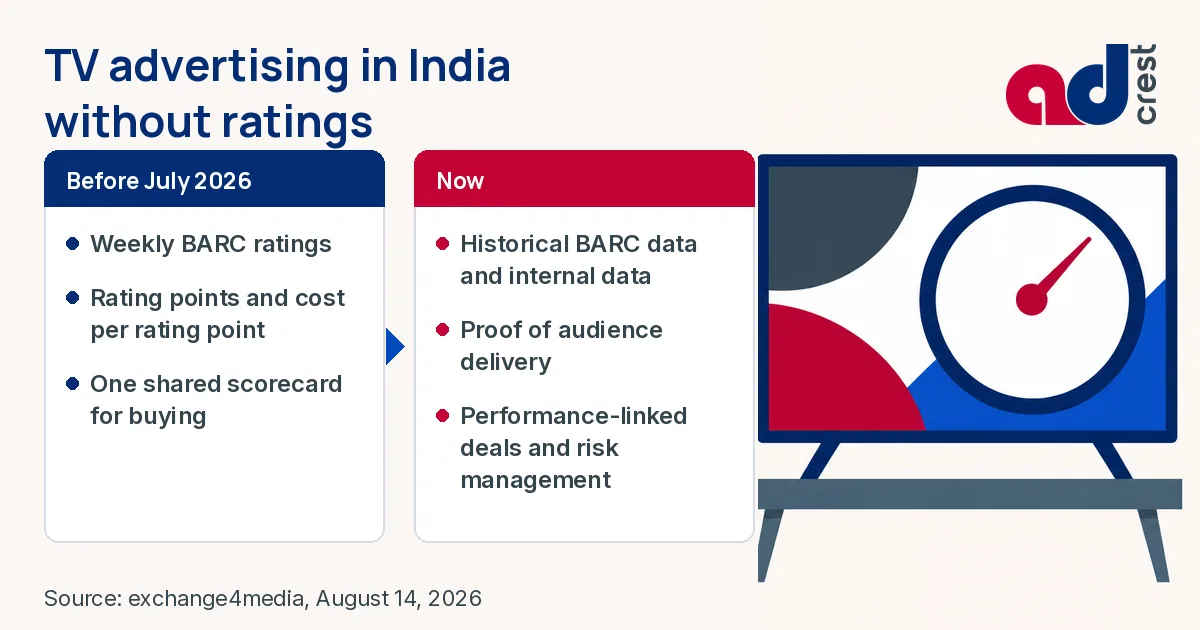
Exchange4media's report on selling TV without ratings found advertisers asking for proof of audience delivery, customized integrations and performance-linked deals. Sales teams are pitching with historical BARC data, their own internal data, consumer research and digital figures. One agency executive told the publication that the conversation has moved from rating points and cost per rating point to risk management.
In an opinion column on November 5, Ravalnath Joshi of Aidem Ventures suggested interim signals to use while ratings are suspended: YouTube traction, DTH (direct-to-home) sampling, ratings led by cable operators (multi-system operators), and FAST (free ad-supported streaming TV) channel inventory. He noted that 32 percent of YouTube users in India watch film and TV content there.
The Confederation of Indian Industry (CII) wants measurement back. In a white paper reported by exchange4media on October 15, it asked for ratings to be restored with interoperable measurement across TV, connected TV and digital. The paper puts India's TV market at $7.1 billion in 2025.
How Should a Brand Plan TV Advertising in India Now?
TV still reaches a very large audience, with over 200 million TV homes in India, according to indiantelevision.com. What has gone is the shared weekly scorecard. TV media planning can adapt to that if it follows a few rules:
- Write the outcome before the plan. Decide whether TV is there for launch reach, trust or retail pull, and name the sales or brand measure that will show it.
- Treat the last BARC data as history. Older ratings show how a channel or show performed before July, and audiences may have moved since.
- Cross-check with volume and your own data. TAM AdEx shows who is on air and how much, while your sales, search and site data show what happened after the flight.
- Ask the seller for proof and flexible terms. Advertisers are already asking for proof of delivery and performance-linked deals, so put these requests in writing before booking.
- Buy in shorter flights. Staggered bursts let you move money toward what works instead of locking a full quarter.
- Hold some budget back. If a ratings system returns or channels change what they offer, you can respond without reopening the whole plan.
Which TV Buying Mistakes Should Brands Avoid Right Now?
Four mistakes show up when a plan leans on old or partial data:
- Quoting old ratings as current. A pre-July figure says little about this month's audience.
- Reading the activity index as spend. The 91.4 figure counts ad activity, so it says nothing about rates or revenue.
- Trusting one signal. A distributor's data covers its own set-top boxes, so GTPL's more than 10,000 RPD-enabled boxes describe only part of the market.
- Dropping TV because of a headline. Volumes fell 6 percent, yet more than 5,800 advertisers stayed on air.
Where Does TV Fit in an ATL Media Mix?
Above-the-line (ATL) advertising covers the mass media that reach broad audiences: television, radio, print, outdoor and cinema. TV brings scale and moving image. Outdoor keeps a brand in front of people on their daily routes, print lends credibility and room for detail, and radio and cinema reach audiences by language and occasion. While TV measurement is in doubt, the other media in the mix carry more of the proof burden, so each one needs its own measure.
For the wider case, read our posts on why ATL advertising still builds the strongest brands and how mass reach advertising shapes consumer perception. For print, read our look at newspaper advertising in India in 2026, and for the outdoor side of the mix, read billboards vs digital ads. AdCrest plans and buys ATL media across outdoor, transit, cinema, radio, retail, OTT and utility platforms, which you can see on our ATL media capabilities page.
The Bottom Line
TV advertising in India is still being bought, on different terms. Weekly ratings have been missing since early July, the policy dispute is open and volumes are lower. A brand that sets its outcome before the buy, checks delivery with more than one source and keeps contract terms flexible does not need the old scorecard back to plan TV.
Planning your next ATL campaign?
Share your brief and city list with AdCrest and talk through how outdoor, transit, cinema, radio and other ATL media can work alongside the rest of your plan.
Book a Call with AdCrestLast updated: November 16, 2026
Frequently Asked Questions
Is TV advertising still worth it in India without ratings?
Yes, but it needs a different plan. TAM AdEx recorded a 6 percent fall in TV ad volumes in January to September 2026, yet more than 5,800 advertisers were still on air. Without current ratings, buyers lean on older BARC data, volume data, their own sales results and proof of delivery from the seller.
What happened to BARC TV ratings in India?
The ministry ordered news ratings withheld on March 6, 2026, and notified the Television Rating Policy 2026 on March 27. BARC India applied for registration on April 29 and was still waiting on November 9. Weekly ratings for all genres have not been published since early July, according to indiantelevision.com.
How are advertisers measuring TV right now?
Sellers are pitching with historical BARC data, internal data, consumer research and digital figures, and advertisers are asking for proof of delivery, exchange4media reported. One columnist also suggests YouTube traction, DTH sampling, cable operator ratings and FAST channel inventory. None is a common industry currency, so a plan should combine several signals.
When will TV ratings return in India?
No date has been announced. A ministry spokesperson told Storyboard18 on November 11 that the industry has not reached a workable solution, and gave no timeline. The minister's November deadline for BARC India is due, and ET BrandEquity reports that BARC may wind up by the end of December without consensus.
Share
Trending Topics
-
 November 20, 2026
DOOH Advertising in India: How Much of It Is Really Programmatic?
-
 November 16, 2026
TV Advertising in India Without TRP Ratings: How to Plan in 2026
-
 November 15, 2026
Newspaper Advertising in India 2026: What the Latest ABC Data Says
-

-
-
 March 09, 2026
-

-
 Feb 23, 2026
-

-
 Feb 09, 2026
-

-
 November 19, 2025
How Are Modern Advertising Agencies Using AI to Boost Campaigns
-
 November 17, 2025
How the Best Outdoor Advertising Agencies in India Stand Out
-
 November 12, 2025
-
 November 10, 2025
How Do You Choose the Best Advertising Agency for Your Business
-
 November 07, 2025
-
 November 01, 2025
Abhishek Gupta
A strategy-led growth architect blending business insight, brand thinking, and execution rigor to build scalable, market-relevant brands.