
Related Articles
Newspaper advertising in India is still worth buying in 2026, but only for brands that choose the right title, city and edition. Audit Bureau of Circulations (ABC) data for January to June 2026 shows several large dailies selling more copies than a year earlier, and print advertising spend grew 3 percent in 2025 to ₹20,866 crore, according to the Pitch Madison Advertising Report 2026. The growth is slow and uneven, so print works best as one planned part of an above-the-line (ATL) media mix.
This guide sets out what the latest numbers say, which categories are still raising print budgets, why advertisers keep choosing newspapers, and how to plan print next to outdoor, radio and cinema. Every figure below is attributed to its source in the section that covers it. The analysis reflects data published up to November 15, 2026.
Key Takeaways
- Print is growing slowly. Spend rose 3 percent in 2025 to ₹20,866 crore and is projected at ₹21,388 crore in 2026.
- Circulation growth is publication-specific. Divya Bhaskar grew 6.33 percent while Malayala Manorama fell 6.42 percent.
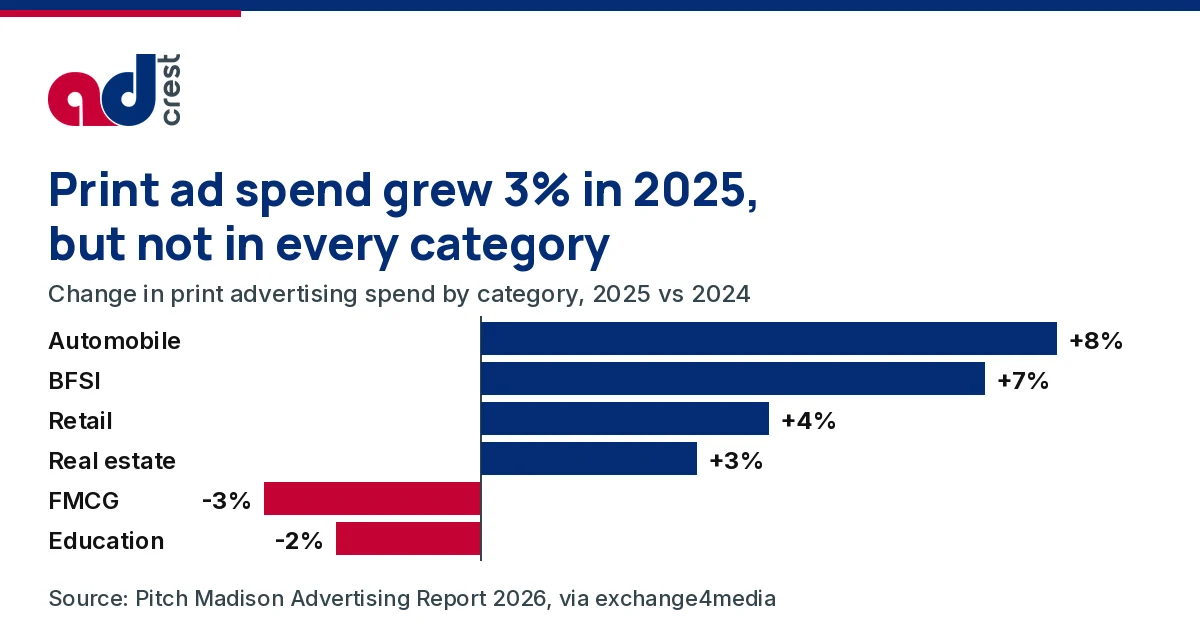
- Categories are split. Automobile (+8 percent) and BFSI (+7 percent) increased print spend, while FMCG (-3 percent) and education (-2 percent) cut it.
- Circulation is one input. Advertisers quoted by exchange4media, including Dabur, weigh effective readership, market relevance and cost.
- Plan by city and edition. Pair print with outdoor and other ATL media rather than buying it in isolation.
In This Article
- What does the latest ABC data say about Indian newspapers?
- How much do advertisers spend on print in India?
- Which categories are increasing newspaper advertising?
- Why do brands still choose newspapers over digital?
- How should a brand plan newspaper advertising in India in 2026?
- Where does print fit in an ATL media mix?
- Frequently asked questions
What Does the Latest ABC Data Say About Indian Newspapers?
The Audit Bureau of Circulations (ABC) certifies the average qualifying sales of its member publications, which makes it a standard reference for newspaper circulation in India. Exchange4media compared ABC figures for January to June 2026 with the same months of 2025. Like-for-like periods matter, because circulation moves with the season.
| Newspaper | Jan to Jun 2025 | Jan to Jun 2026 | Change |
|---|---|---|---|
| Dainik Jagran | 23,53,778 | 24,49,456 | +4.06% |
| Divya Bhaskar | 4,60,989 | 4,90,155 | +6.33% |
| Hindustan | 14,63,341 | 14,83,381 | +1.37% |
| The Times of India | 16,40,418 | 16,58,970 | +1.13% |
| Hindustan Times | 6,19,280 | 6,32,321 | +2.11% |
| The Economic Times | 2,55,567 | 2,50,528 | -1.97% |
| Dainik Bhaskar (Hindi) | 30,40,724 | 30,23,109 | -0.58% |
Other titles lost ground in the same period: Amar Ujala fell 1.53 percent, Rajasthan Patrika fell 2.61 percent and Malayala Manorama fell 6.42 percent, so the picture differs by publication.
A different cut shows why the comparison period matters. An earlier exchange4media analysis against July to December 2025 showed The Times of India down 9.73 percent and Hindustan Times down 14.79 percent, even though both grew year on year. HT Media's national circulation head told exchange4media that seasonal swings make same-period comparison the correct method. Read the full breakdown in exchange4media's analysis of ABC 2026, and read how the audits work on the Audit Bureau of Circulations website.
How Much Do Advertisers Spend on Print in India?
Print advertising expenditure in India rose 3 percent in 2025, from ₹20,272 crore to ₹20,866 crore, according to the Pitch Madison Advertising Report 2026. Advertising volumes grew by only about 1 percent, which exchange4media reads as improved yields and premium inventory contributing to the revenue growth. English newspaper volumes rose 6 percent, lifting their share of print volumes from 28 percent to 30 percent.
The same report projects print spend of ₹21,388 crore in 2026, growth of 2.5 percent. That is modest next to digital. In the report's own table, as published by Social Samosa, print held about 13 percent of India's ₹1.55 lakh crore ad market in 2025 and is forecast at about 12 percent in 2026. Digital held roughly 60 percent in 2025, so most of the growth sits outside print.
Which Categories Are Increasing Newspaper Advertising?
The category split in the Pitch Madison data is the most useful number for a media planner. Newspaper spend moved in different directions in 2025, as the chart above shows:
- Automobile: up 8 percent to ₹3,036 crore.
- BFSI (banking, financial services and insurance): up 7 percent.
- Retail: up 4 percent.
- Real estate: up 3 percent.
- FMCG: down 3 percent.
- Education: down 2 percent.
Automotive explains part of the pattern. Vinay Dholakia, head of digital marketing and media at Tata Motors Commercial Vehicles, told exchange4media that dealers need inquiries at a local level, and that print can be matched to specific editions, dealerships and locations. He also said a passenger vehicle brand cannot afford to be missing from print when rivals advertise there, while adding that the company remains cautious about how much it invests.
Why Do Brands Still Choose Newspapers Over Digital?
Advertisers quoted in the ABC 2026 analysis give three recurring reasons: credibility, regional reach and room for detail.
Rajiv Dubey, head of media at Dabur India, described print as the medium that brings attention, context and market-level relevance, while television delivers scale and digital delivers precision and measurability. Ullas Vijay, chief marketing officer at Duroflex, said print suits considered purchases such as mattresses and furniture, where buyers compare features and long-term value. Duroflex used newspapers to extend its World Sleep Day campaign to a wider readership. An Emami spokesperson said print remains effective for mass outreach, new launches and credibility in markets where newspaper readership is strong.
Dubey also pointed out that circulation measures distribution, which is separate from influence or advertising effectiveness. Dubey said Dabur weighs effective readership, audience profile, market relevance, brand affinity and cost efficiency, and treats ABC numbers as one planning input.
How Should a Brand Plan Newspaper Advertising in India in 2026?
The data points to a more selective way of buying print. Based on the figures above, this is how a planner can approach print:
- Start with the objective. A national launch, a dealership footfall push and a trust-building message each call for a different title and edition.
- Buy by city and edition, not headline circulation. Even inside one publishing group, results differ. Dainik Bhaskar (Hindi) slipped 0.58 percent while Divya Bhaskar grew 6.33 percent.
- Compare the same ABC period each year. January to June against January to June removes seasonal noise.
- Use print where detail matters. Considered purchases and complex offers benefit from space that a short digital unit does not offer.
- Decide the measure before the campaign. Inquiries, dealership visits or recall should be defined first, then read next to the response from outdoor and digital activity.
What Are the Common Mistakes in Buying Print?
Four errors are easy to make when a plan leans on newspaper numbers it has not read closely:
- Ranking titles by national circulation alone. A title can lead nationally and still be the wrong buy for a single city.
- Mixing audit periods. Comparing January to June with July to December can make a healthy title look weak, or the reverse.
- Treating circulation as effectiveness. Copies sold say nothing about whether the right reader saw the message.
- Leaving print out of the measurement plan. Without a defined response measure, print gets judged on instinct.
Where Does Print Fit in an ATL Media Mix?
Above-the-line (ATL) advertising is mass-media advertising that reaches broad audiences through television, radio, print, outdoor and cinema. Each medium does a different job: print adds credibility and detail, outdoor adds repeated visibility in the city where the buyer lives and travels, and radio and cinema add reach by language and moment.
Outdoor is drawing attention in the same week. Bright Outdoor Media has moved from the BSE SME platform to the main boards of BSE and the National Stock Exchange of India, exchange4media reported on November 11, 2026. The Mumbai company reported FY26 revenue of ₹155.43 crore and net profit of ₹24.05 crore, and operates more than 1,350 hoardings (static billboards) and over 50 digital LED billboards in Mumbai, according to exchange4media's report on the listing. Print, outdoor, radio and cinema are each bought and measured on their own terms, so a plan should size each one separately.
We cover the wider case in our posts on why ATL advertising still builds the strongest brands and how mass reach advertising shapes consumer perception. For the outdoor side of the mix, read billboards vs digital ads. AdCrest plans and buys ATL media across outdoor, transit, cinema, radio, retail, OTT and utility platforms, which you can see on our ATL media capabilities page.
The Bottom Line
Print is a selective medium with slow growth. It rewards brands that match the title, city and category to a clear goal. Automobile, BFSI, retail and real estate raised print spend in 2025. The advertisers quoted above point to local selling and considered purchases as the reasons print still earns budget.
Planning your next ATL campaign?
Share your brief and city list with AdCrest and talk through how outdoor, transit, cinema, radio and other ATL media can work alongside your print plan.
Book a Call with AdCrestLast updated: November 15, 2026
Frequently Asked Questions
Is newspaper advertising still effective in India in 2026?
Yes, for the right brief. Print advertising spend grew 3 percent in 2025 to ₹20,866 crore, and several large dailies reported higher circulation in January to June 2026. Effectiveness depends on category, city and edition, so brands should buy print against a clear objective.
How much did India spend on print advertising in 2025?
According to the Pitch Madison Advertising Report 2026, print advertising expenditure in India rose 3 percent from ₹20,272 crore to ₹20,866 crore in 2025. The report projects ₹21,388 crore for 2026, which is growth of 2.5 percent. Print is roughly 13 percent of India's total ad market.
What does ABC circulation data measure?
The Audit Bureau of Circulations certifies the average qualifying sales of member newspapers, meaning the copies a title sells in an audit period. That figure is separate from influence, so advertisers quoted by exchange4media, including Dabur, say they weigh effective readership, audience profile, market relevance and cost before committing budget.
Which categories are growing their print ad spend?
Pitch Madison data shows automobile print spend rising 8 percent to ₹3,036 crore in 2025, BFSI up 7 percent, retail up 4 percent and real estate up 3 percent. FMCG fell 3 percent and education fell 2 percent. Advertiser comments point to local selling and considered purchases as the reasons print still earns budget.
Share
Trending Topics
-
 November 20, 2026
DOOH Advertising in India: How Much of It Is Really Programmatic?
-
 November 16, 2026
TV Advertising in India Without TRP Ratings: How to Plan in 2026
-
 November 15, 2026
Newspaper Advertising in India 2026: What the Latest ABC Data Says
-

-
-
 March 09, 2026
-

-
 Feb 23, 2026
-

-
 Feb 09, 2026
-

-
 November 19, 2025
How Are Modern Advertising Agencies Using AI to Boost Campaigns
-
 November 17, 2025
How the Best Outdoor Advertising Agencies in India Stand Out
-
 November 12, 2025
-
 November 10, 2025
How Do You Choose the Best Advertising Agency for Your Business
-
 November 07, 2025
-
 November 01, 2025
Abhishek Gupta
A strategy-led growth architect blending business insight, brand thinking, and execution rigor to build scalable, market-relevant brands.