
Related Articles
DOOH advertising in India is growing, but very little of it is bought programmatically. DOOH means digital out-of-home: ads on screens in public and shared places. Depending on the yardstick, executives quoted by exchange4media on November 19, 2026 put genuinely programmatic DOOH at under 1 to 2 percent of spend or under 5 percent of available inventory, and one cited a FICCI-EY estimate of about 15 percent of volumes. The rest is still sold the traditional way, as screens and time slots agreed in advance. A brand can use DOOH well today by buying premium sites directly and using programmatic only where delivery can be verified.
This guide covers this week's news, how big the market is, why programmatic lags and how to buy DOOH. It reflects reports published up to November 19, 2026.
Key Takeaways
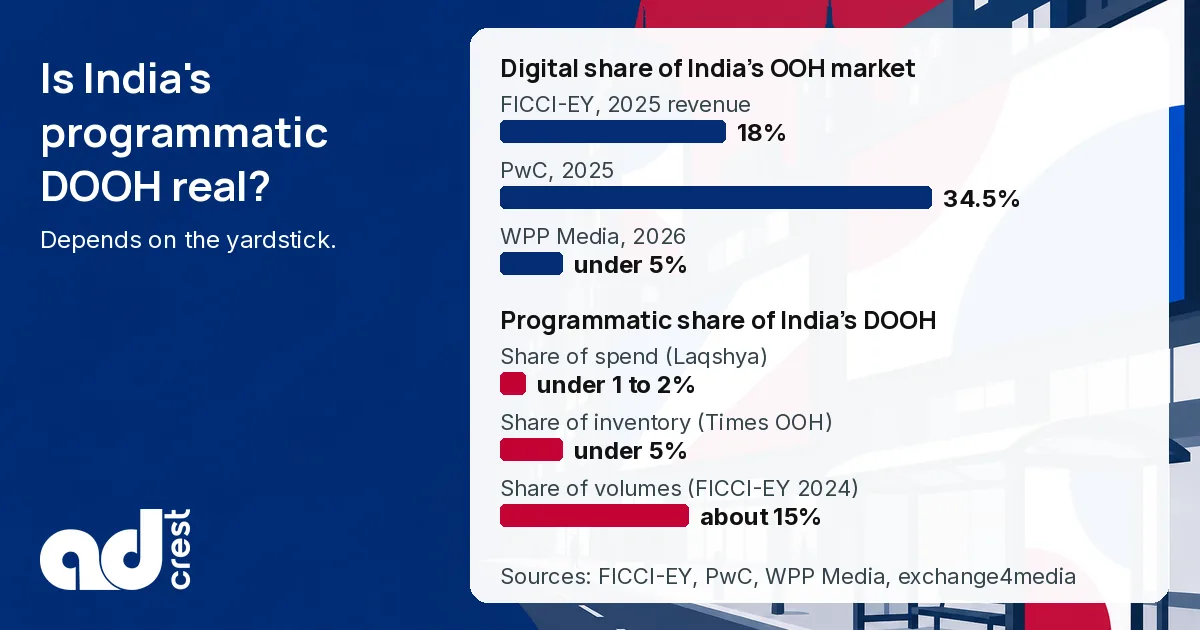
- Programmatic DOOH is a small slice. Executives quoted by exchange4media put it at under 1 to 2 percent of spend or under 5 percent of inventory, and one cited a 2024 estimate of about 15 percent of volumes.
- Market size depends on the definition. FICCI-EY puts digital at 18 percent of OOH revenue in 2025, PwC at about 34.5 percent and WPP Media at under 5 percent in 2026.
- Measurement is the bottleneck. Executives point to no unified currency, thin proof of play and screens that are still sold by time, not impressions.
- The big deals are not confirmed as closed. The Mygate and AdOnMo merger and Affle's purchase of Perion are pending, and neither proves who saw an ad.
- Plan a hybrid. Book premium sites directly and use programmatic where proof of play and audience data can be verified.
In This Article
- What did this week's DOOH advertising news show?
- What is DOOH advertising, and what makes it programmatic?
- How big is DOOH advertising in India in 2026?
- Why is programmatic DOOH still so small in India?
- What do the AdOnMo, Mygate and Affle deals change?
- Where does DOOH work best for brands right now?
- How should brands buy DOOH in 2026?
- The bottom line
- Frequently asked questions
What Did This Week's DOOH Advertising News Show?
Image: exchange4media. Click to read the full report.
The headline report came from exchange4media on November 19. Three outdoor executives gave three different answers on how much of India's DOOH is programmatic, and a fourth gave no figure. Yuvrraj Agarwaal, chief strategy officer at Laqshya Media Group, put real programmatic at under 1 to 2 percent of DOOH spend. Rohit Chopra, deputy CEO of Times OOH, said less than 5 percent of available DOOH inventory is genuinely programmatic. Jayesh Yagnik, CEO of MOMS Outdoor Media Solutions, cited the FICCI-EY 2024 report, which, citing Moving Walls estimates, put programmatic at about 15 percent of DOOH volumes and direct deals at 85 percent, and said the market has evolved since. Dipankar Sanyal, CEO of Platinum Communications, said programmatic has not kept pace with DOOH's growth.
Agarwaal also said many deals sold as programmatic have screens and rates agreed in advance, with a platform only scheduling and reporting. Counting those deals, he said, makes programmatic look like about a third of DOOH.
Three related items landed the same week. On November 18, Media4Growth reported that AdOnMo connected its Indian DOOH network to VIOOH's global programmatic marketplace. The same day it reported that GAP ran its first anamorphic DOOH campaign in India. And exchange4media's Pitch BrandTalk in Gurugram, scheduled for November 20, lists a programmatic DOOH panel, with an agenda covering third-party verification, brand lift studies and entry for small and mid-sized brands. We have not seen any coverage of what the panel said.
What Is DOOH Advertising, and What Makes It Programmatic?
DOOH is advertising on digital screens in public and shared places. In India that covers large LED screens, airports, metros, malls, corporate campuses and the screens inside residential societies. BW Disrupt, for example, describes digital screens in residential common areas such as lobbies, gates, clubhouses and elevators. A digital screen can rotate several ads in a loop and change creative without reprinting.
Programmatic means software buys the space. A buyer uses a demand-side platform (DSP) to plan and bid for audiences, and a media owner lists screens through a supply-side platform (SSP). Chopra gave a practical test in the exchange4media report: can agencies plan, buy and execute through their own DSPs without coordinating with individual media owners? By that test, a fixed-rate deal that a platform only schedules and reports is digital delivery, not programmatic buying, which matches Agarwaal's point above.
Chopra also separates digitization from automation and says real adoption needs integration across inventory management, planning, buying platforms, scheduling and measurement.
How Big Is DOOH Advertising in India in 2026?
Three published estimates give three different digital shares of India's outdoor market.
| Source | What it says |
|---|---|
| FICCI-EY | DOOH was 18% of OOH revenue in 2025, up from 7% in 2023 |
| PwC Outlook 2026-30 | DOOH about $193 million of about $558.9 million OOH in 2025, a share of about 34.5% |
| WPP Media | OOH up 8.6% to $0.5 billion in 2026, with DOOH still under 5% of that |
These numbers likely differ because they are not measuring the same thing. Agarwaal, citing WPP, described the under-5 percent figure as DOOH that can be planned, bought and verified like digital media. The FICCI-EY and PwC shares are far higher, which points to a broader count of digital screens, although we have not seen the full method behind any of the three. exchange4media's October 21 report adds that fragmented ownership and inconsistent reporting make India's OOH market hard to size, and that local, dealer-led and temporary activity may sit outside the estimates.
FICCI-EY said OOH grew 13 percent in 2025, and advertising overall grew 13 percent to ₹1.5 trillion. PwC expects DOOH revenue to rise from $193 million in 2025 to $318.5 million in 2030, while physical OOH slips from $365.9 million to $326.3 million, according to Everything Experiential.
Why Is Programmatic DOOH Still So Small in India?
Executives quoted in the exchange4media report point to these reasons:
- No shared audience currency. Dipankar Sanyal, CEO of Platinum Communications, said India has no unified measurement currency and outdoor is still sold as round-the-clock display time, not impressions.
- Owners are not on the platforms. Sanyal also said most media owners do not access supply-side platforms.
- Prime sites sell out in advance. Agarwaal said airport and prime-junction sites sell out on annual and festive deals at negotiated rates, and premium large-format screens are only 2 to 3 percent of about 225,000 DOOH screens.
- A long tail of small screens. Citing FICCI-EY, Agarwaal said 53 percent of India's digital screens are residential and 76 percent are under 36 inches, spread across thousands of owners with different loop lengths and slot durations.
- Weak proof of play. Many screens have no independent proof of play, so a buyer cannot confirm that an ad ran or how many brands share the loop, Agarwaal said.
- Two buying desks. In most companies the OOH team buys sites and the digital desk buys impressions, so programmatic DOOH falls between them, he said.
What Do the AdOnMo, Mygate and Affle Deals Change?
Image: Media4Growth. Click to read the full report.
The VIOOH link, reported by Media4Growth on November 18, puts AdOnMo's inventory across residential communities and corporate campuses into a global programmatic marketplace and opens it to international advertisers. The report gives no screen count for the integration.
AdOnMo is also part of a proposed merger with Mygate, a residential community platform. BW Disrupt reported on October 22 that the share-swap deal would join Mygate's 6 million (60 lakh) households across 30,000 communities with AdOnMo's more than 55,000 connected screens in 27 cities. Eternal would hold about 4.4 percent of the combined entity, and Eternal's disclosures expect completion by December 5, although the companies had not commented on the timeline. Agarwaal put the combined value at about ₹3,500 crore in the exchange4media report.
What Does Affle's Perion Deal Add?
Image: invidis. Click to read the full report.
Affle agreed to buy Perion, which owns the DOOH platform Hivestack, in a deal worth US$420 million, invidis reported on November 2. The deal needs Perion shareholder approval and is expected to close in early 2027.
Agarwaal's reading, as exchange4media reports it, is that the first deal consolidates supply and the second builds pipes, but neither proves who saw an ad. More connected screens and better platforms may make programmatic buying easier. By Agarwaal's reading, they do not fix proof of play or audience measurement. The reports we read do not confirm either deal as completed.
Where Does DOOH Work Best for Brands Right Now?
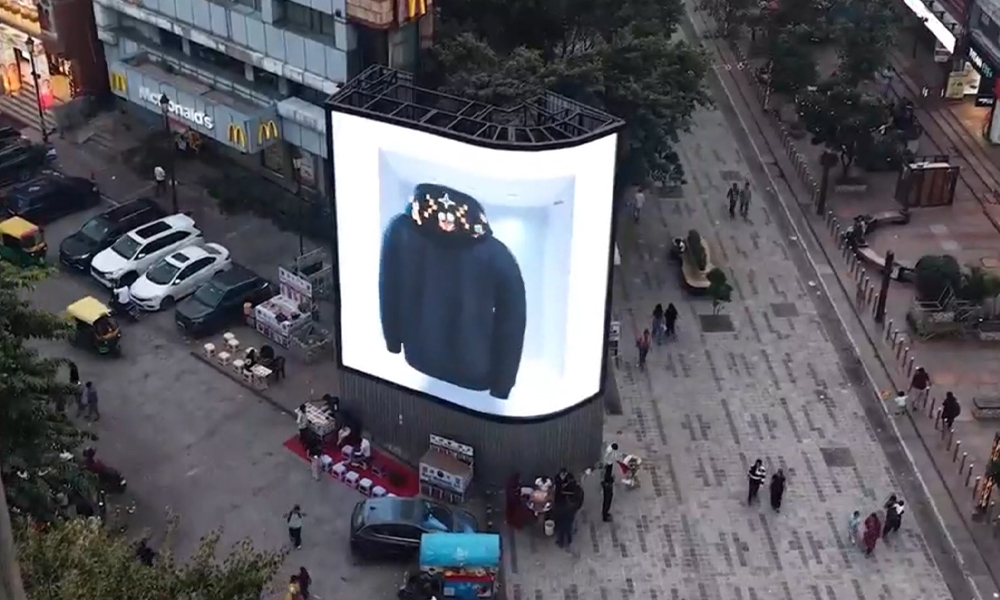
Image: Media4Growth. Click to read the full report.
Media4Growth reported on November 18 that GAP added anamorphic DOOH to its India marketing mix for the first time, showing its latest collection at Phoenix Palladium in Mumbai and DLF Mall of India in Noida. The DLF execution uses what Media4Growth calls one of India's largest DOOH screens, and 3D visuals play with scale, perspective and motion. The report names no agency, media owner or buying method and gives no results.
That is the premium end of DOOH. The long tail of small screens sits at the other end. Chopra, Yagnik and Agarwaal all expect direct and programmatic buying to coexist, and Chopra calls it a hybrid ecosystem. Yagnik described the direction this way: "the real shift is from buying screens to buying audiences."
How Should Brands Buy DOOH in 2026?
Use these checks before signing a DOOH plan:
- Define "programmatic" in writing. Ask whether the offer is auction-based buying through a platform or a fixed deal that a platform only schedules and reports.
- Ask for independent proof of play. Without it, you cannot confirm that your ad ran when and where it was agreed.
- Ask how many brands share the loop. Loop length and slot duration vary by owner, so your share of screen time is part of the price.
- Ask where the audience data comes from. Find out who verifies it. The Pitch BrandTalk agenda lists screen health, playout delivery and geo-accuracy as verification points.
- Mix premium and programmatic. Book premium sites directly for impact, and test programmatic on other inventory where delivery can be verified.
- Test against a control. Compare exposed and unexposed audiences on recall or intent. The same agenda includes control-versus-exposed brand lift studies.
For the wider outdoor picture, read our posts on OOH advertising metrics every brand should track, billboards vs digital ads and how OOH advertising drives brand recall.
AdCrest's capabilities page lists Digital Out-of-Home (DOOH) among its ATL media services, including large-format LED screens, city-level DOOH networks and time-based and contextual media planning. If you are comparing agencies, see how the best outdoor advertising agencies in India stand out.
The Bottom Line
DOOH advertising in India is real and growing, but programmatic DOOH is still a small share of it, and the size of that share depends on who is counting. Yagnik describes the direction as buying audiences instead of screens, and the executives quoted name the missing pieces: a shared currency, proof of play and verified audience data. A brand that asks for proof, defines the buying terms in writing and keeps a premium-plus-programmatic mix can use DOOH now without waiting for the market to settle.
Planning DOOH or outdoor for your next campaign?
Share your brief and city list with AdCrest and talk through how DOOH, outdoor, transit and other ATL media can work alongside the rest of your plan.
Book a Call with AdCrestLast updated: November 20, 2026
Frequently Asked Questions
What is DOOH advertising?
DOOH is digital out-of-home advertising: ads shown on digital screens in public and shared places such as roadside LED screens, airports, metros, malls, corporate campuses and residential societies. Screens can rotate several ads in a loop and change creative quickly. Programmatic DOOH is the part bought through software platforms instead of fixed, pre-agreed deals.
How much of India's DOOH is programmatic?
It depends on the yardstick. Laqshya's Yuvrraj Agarwaal puts genuinely programmatic DOOH at under 1 to 2 percent of spend, Times OOH's Rohit Chopra at under 5 percent of available inventory, and a FICCI-EY 2024 estimate cited by MOMS Outdoor's Jayesh Yagnik at about 15 percent of volumes, according to exchange4media.
What share of India's outdoor advertising is digital?
FICCI-EY puts digital at 18 percent of OOH revenue in 2025, up from 7 percent in 2023. PwC's 2026-30 outlook puts it at about 34.5 percent, and WPP Media says DOOH is still under 5 percent of a $0.5 billion OOH market in 2026. The gap likely reflects different definitions of DOOH.
Why isn't premium DOOH bought programmatically?
Airport and prime-junction sites sell out on annual and festive deals at negotiated rates, Yuvrraj Agarwaal of Laqshya Media Group told exchange4media. Premium large-format screens are only 2 to 3 percent of India's roughly 225,000 DOOH screens, and many screens have no independent proof of play.
What should a brand ask before buying DOOH?
Ask for independent proof of play, how many brands share the loop, where the audience data comes from and who verifies it. Also ask whether programmatic means auction-based buying through a platform or a fixed deal that a platform only schedules. The Pitch BrandTalk agenda lists screen health, playout delivery and geo-accuracy as verification points.
Share
Trending Topics
-
 November 20, 2026
DOOH Advertising in India: How Much of It Is Really Programmatic?
-
 November 16, 2026
TV Advertising in India Without TRP Ratings: How to Plan in 2026
-
 November 15, 2026
Newspaper Advertising in India 2026: What the Latest ABC Data Says
-

-
-
 March 09, 2026
-
-
 Feb 23, 2026
-
-
 Feb 09, 2026
-
-
 November 19, 2025
How Are Modern Advertising Agencies Using AI to Boost Campaigns
-
 November 17, 2025
How the Best Outdoor Advertising Agencies in India Stand Out
-
 November 12, 2025
-
 November 10, 2025
How Do You Choose the Best Advertising Agency for Your Business
-
 November 07, 2025
-
 November 01, 2025
Abhishek Gupta
A strategy-led growth architect blending business insight, brand thinking, and execution rigor to build scalable, market-relevant brands.